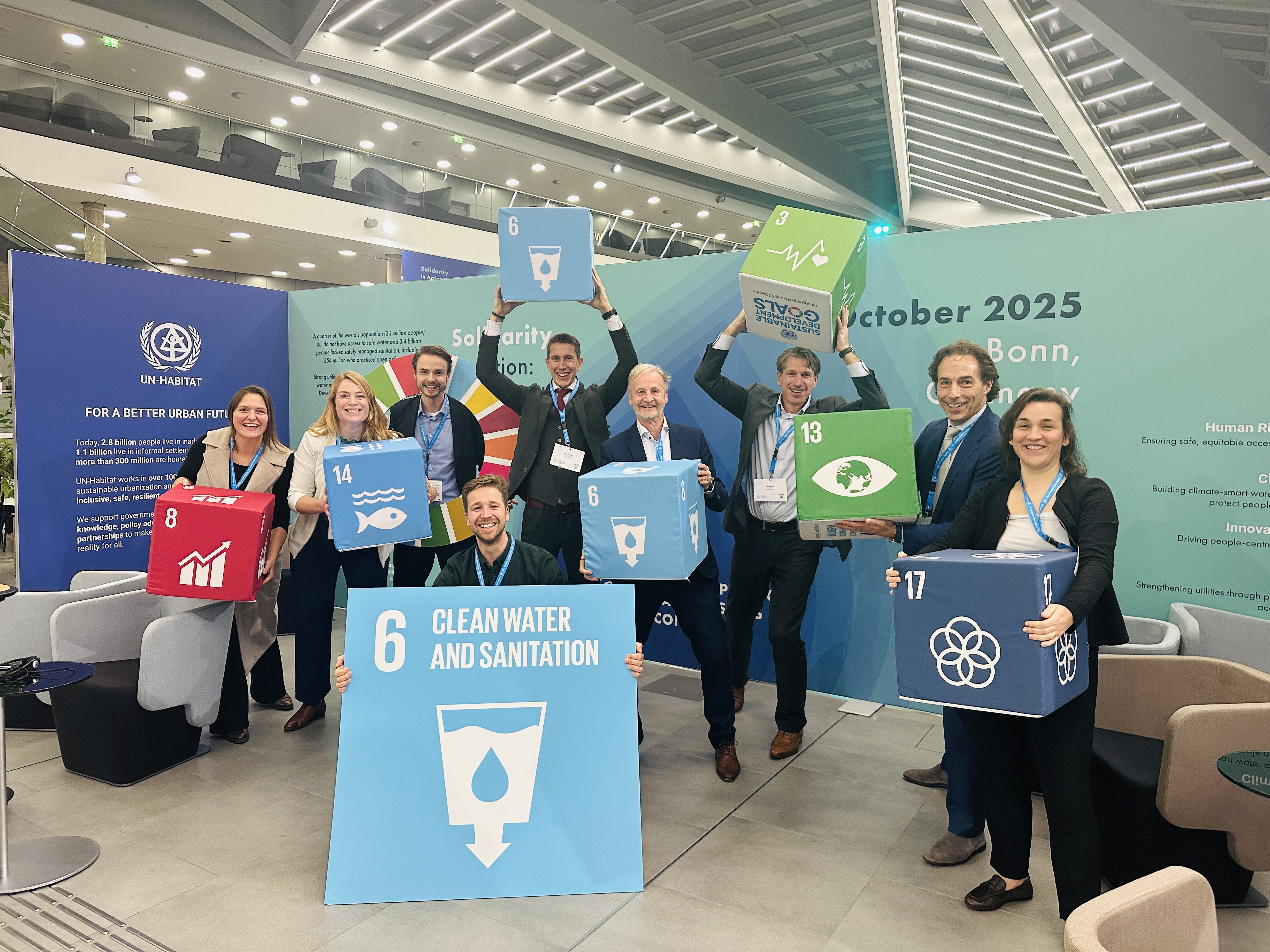
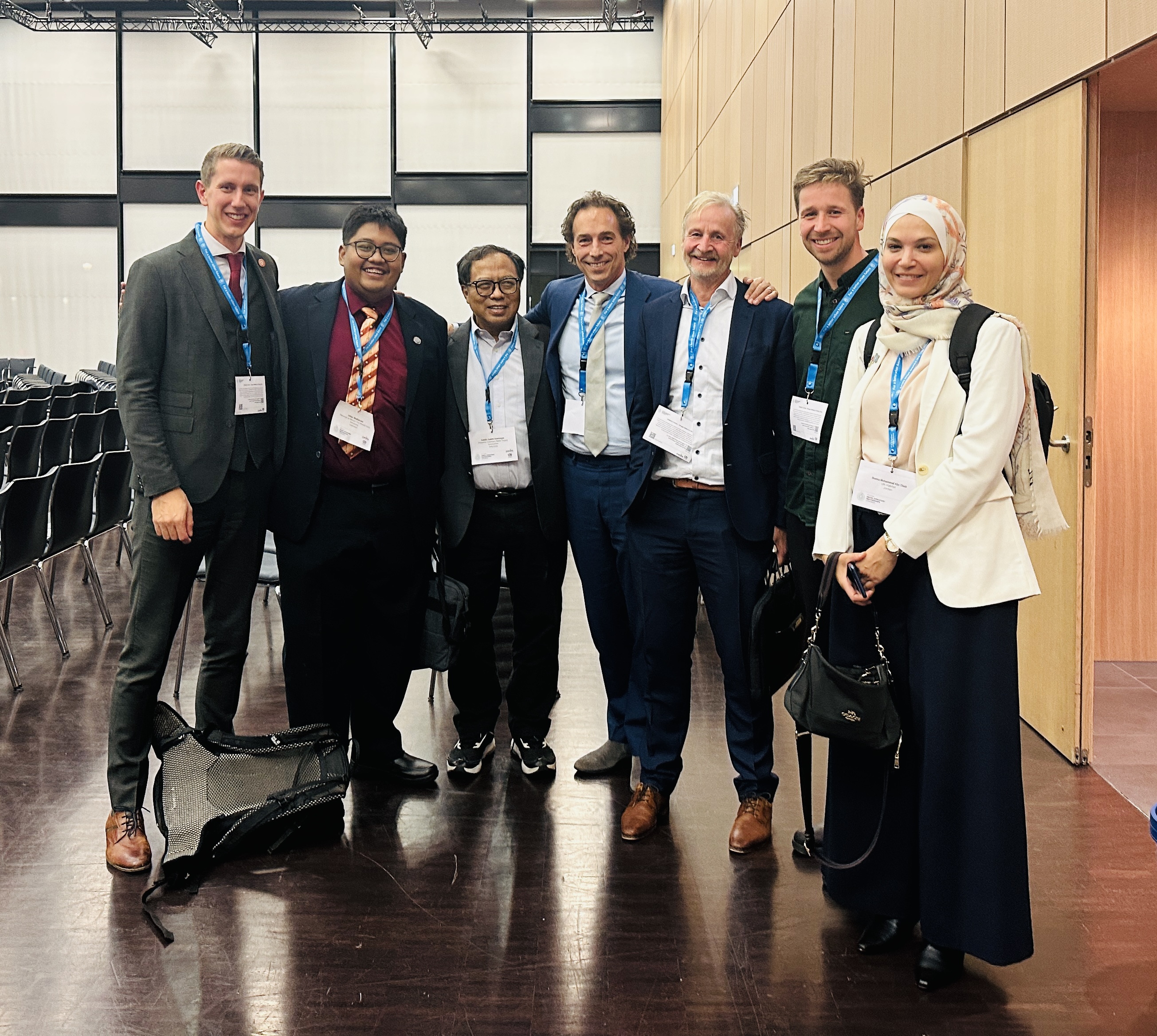
At the 6th Global Water Operators’ Partnerships Alliance (GWOPA) Congress in Bonn, global water leaders reaffirmed a simple truth: strong utilities are essential to achieving the Sustainable Development Goals and building resilient, inclusive cities. Under the theme “Solidarity in Action: Stronger Utilities for Thriving Cities,” the Congress brought together operators, governments and partners from around the world to share how trust-based partnerships are transforming the water sector.
World Waternet’s delegation added practical insights to these global discussions. Partnership Director MENA Kees van der Lugt explored how blended finance and an open system approach can strengthen regional cooperation. Joost Verbart (Waternet), Moderator of the Community of Practice on Asset Management, linked fieldwork to performance goals through data-driven asset management. Arnout van Balen, Project Leader EU-WOP Mali, highlighted how Nature-based Solutions strengthen utilities and communities, and Pepijn van Loon, Project Leader WaterWorX Jordan, shared how his team moved from reactive to condition-based maintenance in sanitation systems.
What is a Water Operators’ Partnership?
If you are not familiar with the Water Operators Partnership model, or WOP for short, don’t worry, you wouldn’t be the only one. The concept is quite simple:
“Water Operators’ Partnerships (WOPs) are peer-support partnerships between water and sanitation service providers. WOPs work by harnessing the skills, knowledge and goodwill within a strong utility to build the capacity and improve the performance of another utility that needs assistance or guidance.” – GWOPA/UN-Habitat
So, WOPs are a way of strengthening capacity and expertise through direct collaboration between water operators. They were first introduced in 2007 by UN-Habitat with the launch of the Global Water Operators Partnership Alliance (GWOPA).
Water Operators’ Partnerships are maturing
The Water Operators’ Partnership (WOP) concept has been around for almost two decades. In 2025, it is entering a new phase. Interest in WOPs is maturing, the demand for partnerships is higher than ever, and for the first time, significant financing is becoming available to scale impact. What began as a solidarity-based approach to strengthen public utilities has evolved into a recognised pathway to resilience and investment readiness.
At the 6th Global Water Operators’ Partnerships Congress in Bonn, global leaders reaffirmed this momentum. UN-Habitat Executive Director Anacláudia Rossbach urged participants to advance the GWOPA pledge to establish 100 new Water and Sanitation Operators’ Partnerships by 2030, reaching 100 million people through solidarity in action. Indonesia’s former Foreign Minister and newly appointed UN Special Envoy on Water, Retno Marsudi, echoed the call to scale from local to global levels and to serve as “narrators of hope, action and solutions.”
The Urban Water Catalyst Initiative is here
A highlight of the week was the launch of the Urban Water Catalyst Initiative (UWCI), a new global foundation to mobilise investment for utilities in the Global South. With the German Federal Ministry for Economic Cooperation and Development, GIZ, and KfW among the founding partners, the UWCI aims to strengthen financial independence and performance of utilities through tailored financial and technical support.
As Frodo van Oostveen, World Waternet CEO, reflected: “Healthy utilities must change their game. Financial sustainability and strong local leadership are key to long-term impact.”
Celebrating EU-WOP phase 1 and reaching new countries in phase 2
The new UWCI initiative is not the only extra source of funding for WOPs. The EU-funded Water Operators’ Partnerships (EU-WOP) Programme is also entering an exciting new chapter. Partners from across the world met in Bonn to mark the conclusion of its first phase, reflecting on how partnerships have strengthened utilities, advanced innovation and climate resilience, and supported the human rights to water and sanitation. World Waternet shared lessons from its collaboration with SOMAGEP in Mali and ONEE in Morocco, where peer-to-peer exchange has helped utilities improve service delivery and operational maturity. Building on these results, World Waternet is now preparing to implement Phase 2 of the EU-WOP Programme in Ethiopia and Lao PDR, while continuing its support in Mali to consolidate progress and expand regional impact.
As Arnout van Balen, the Project Leader for the EU-WOP Mali project remarked: “We are all working together on the same issues, and you have people from Morocco, Ghana, Canada, Indonesia, Palestine, the Netherlands. For all these different backgrounds to come together, that’s the real value of such events.”
Nature-based Accounting and Green-Grey Portfolios
Speaking of investments, did you know that 99.9 investments go into Gray infrastructure (human engineered systems) in water management? That is why the conference stressed the importance of nature-based accounting, a growing recognition that natural assets such as wetlands, forests, and eco-systems provide quantifiable services that can strengthen the financial and operational resilience of utilities.
In sessions on nature-based solutions (NbS), utilities and operators demonstrated how green-grey portfolios can reduce costs, enhance adaptability, and contribute to climate resilience. Moderated by our team, the session displayed solutions from all around the world. For example, the Indonesian water utility of Semarang City explained how the WaterWorX program and The Nature Conservancy had supported them to protect the catchment area. Various Nature-based Solutions were implemented throughout the last years. Reforestation, agroforestry, terraced farming, riparian buffers and intercropping were some of the implementations. Hence, this case highlighted the potential of Nature-based Solutions to mitigate the effects of climate change on the availability of water.
Data that drives investment
Joos Verbart and Pepijn van Loon as Community of Practice Moderators for the topics of Asset Management and Sanitation combined forces during the GWOPA conference in Bonn. We had the pleasure to present the Asset Management roadmap to the wider audience of the water sector.
What is asset management?
When you mention asset management, most people don’t have a clue what you are talking about. But when you replace your phone’s screen, or you go to the bike shop to get your tires fixed, then you are doing Asset Management. Everyone is affected by Asset Management, and especially water utilities. That is why Joost started to develop an Asset Management Roadmap with various experts from World Waternet and VEI, to guide people in making more informed decisions their assets. Because you need know where your water network is, what the status of the network is, before you decide to clean or to replace any missing pipes. These actions can cost a lot of money, and therefore decisions are important to consider.
Our colleagues from Regieteam Afvalwater have been training local staff in Jordan how to better clean their sewers. They experienced many complaints from citizens about overflowing manholes, and the problems kept reemerging (literally). When our colleagues visited Jordan, they first inspected the sewer lines, by mapping out the network and looking inside the sewers for the status. They advised that most sewer pipes needed to be cleaned, rather than replaced. For 5 years, they trained the local staff and brought in equipment to do their work accurately and safely.
In other words, they taught the principles of Asset Management to the Jordanian Utility. The result was a reduction of complaints by 90% and more than 30km of clean sewer pipes.
Joost and Pepijn were very happy that we could combine the theory of Asset Management and the practices of World Waternet in this presentation at Bonn.
Diversity works
The Congress also underscored that diverse and inclusive teams are not only fairer but more effective. As van Oostveen shared, “Diversity and female leadership in utilities and WOPs are inspiring business cases; they drive progress and innovation.”
Promoting youth and women in water cooperation remains a core GWOPA priority and a key element of World Waternet’s partnerships, from Mali to Laos.
Partnerships Built on People
Beyond frameworks and funding, the week in Bonn reaffirmed a deeper message: impact is about people. Many of World Waternet’s partner utilities, from Indonesia to Ukraine, continue to stay in close contact with Dutch colleagues, exchanging ideas, updates, and inspiration long after projects close. These enduring relationships are the essence of Water Operators’ Partnerships: solidarity translated into action.